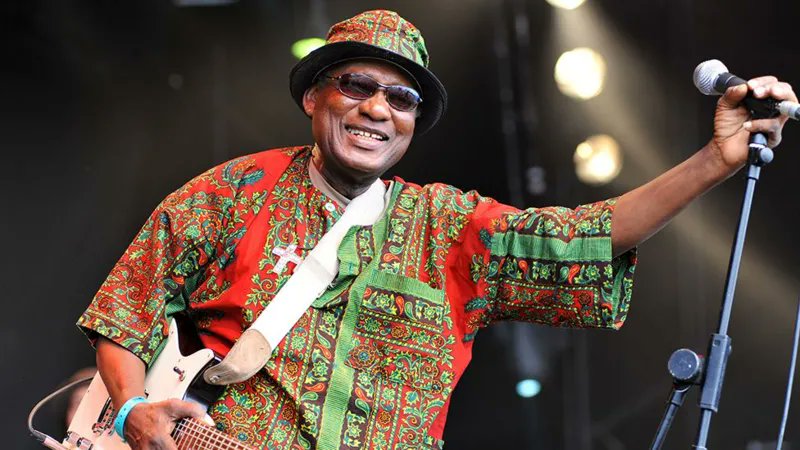
Ghanaian music icon Ebo Taylor has died at the age of 90. His passing was confirmed on Sunday, February 8, 2026, a day after he died on Saturday, February 7. The news was shared publicly by his son, Kweku Taylor, who announced the loss in an emotional social media post.
The world has lost a giant. A colossus of African music. Ebo Taylor passed away yesterday; a day after the launch of Ebo Taylor Music Festival and exactly a month after his 90th birthday, leaving behind an unmatched artistry legacy. Dad, your light will never fade.
The timing carried a painful symmetry. Taylor had turned 90 in January. Just a day before his death, a festival bearing his name had been launched to honour his contribution to Ghanaian music.
A Life Rooted in Highlife and Shaped by History
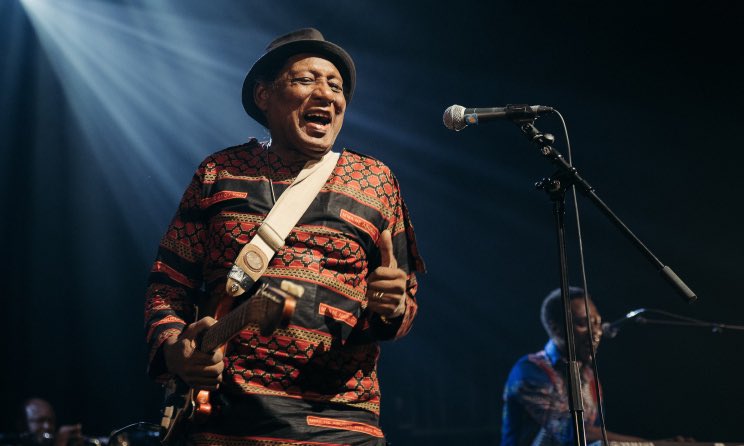
Born Deroy Taylor on January 6, 1936, in Cape Coast, Ebo Taylor became one of the defining architects of modern Ghanaian highlife. His career began in the late 1950s when he joined influential bands such as The Stargazers and later the Broadway Dance Band. At a time when Ghana was redefining itself politically and culturally, Taylor’s guitar lines and arrangements were helping define its sound.
In the early 1960s, he travelled to London and attended the Eric Gilder School of Music, deepening his understanding of composition and theory. It was during this period that he met Fela Kuti, a relationship that would influence both musicians. Speaking years later about their conversations, Taylor recalled Fela’s insistence on authenticity:
Fela used to say to me, ‘Why are we Africans always playing jazz?’ He said jazz was for the Americans and we should be doing our own thing.
(Vinyl Factory interview, 2018)
That push toward African-rooted innovation shaped Taylor’s direction. While jazz remained an influence, he fused highlife with funk and Afrobeat rhythms, creating arrangements that were structured yet fluid, rooted yet outward-looking.
Beyond Highlife: A Bridge Between Generations
Taylor was not only a performer; he was a composer, arranger, producer, and bandleader. Over six decades, he formed and led multiple bands and worked with major Ghanaian artists, including Pat Thomas and C.K. Mann.
His influence did not fade with time. In the 21st century, younger audiences discovered his catalogue through reissues and samples. International producers revisited his work, and his music found renewed life beyond West Africa. Albums such as Love and Death (2008), Appia Kwa Bridge (2012), and Yen Ara (2018) reintroduced him to global listeners.
Even into his late 80s, Taylor remained active. In 2025, he released music under the Jazz Is Dead series, proving that his creative drive had not dimmed.
Dr. Amos Anyimadu, who worked closely with him, described Taylor’s individuality and long view of legacy:
Ebo Taylor, as I characterized him about thirty years ago – Guitar virtuoso, Highlife Originator, Afrobeat Significant – was unique and did things his own way, including the timing of ascension. Perhaps now that he is gone, Ghana will do the right thing in honouring him.
Tributes From Ghana and Beyond
The Musicians Union of Ghana (MUSIGA) also confirmed his passing. Its president, Bessa Simons, stated:
Ghana and indeed the world has lost a great son.
In its tribute, MUSIGA added:
Uncle Ebo Taylor Rest in perfect peace.
Across social media, fans echoed similar sentiments. Many described him as “a pillar of highlife,” “a teacher through music,” and “a bridge between generations.” Others reflected on how his guitar tone carried a distinct Ghanaian identity at a time when African musicians were negotiating global influence.
newenafrobeat Thanks for everything! ❤️❤️ You legacy and music! Vivirás por siempre en nuestros corazones 🔥🔥
trigmaticofficial You gave us the best of you sir ! RIP . A life well lived
soundsofmigrantsofficial❤️❤️❤️ Legends never die, they multiply. You passed the torch on and lit new torches across the world. Safe journey
His passing comes at a moment when African music occupies a visible place on global charts. Long before that visibility, Taylor and his peers were shaping the foundation.
A Career That Refused to Slow Down
Few musicians remain creatively active into their ninth decade. Taylor did. He performed internationally well into his 80s, often appearing alongside younger musicians who grew up studying his work.
He once reflected on the musical ambitions he shared with Fela during their London years:
We also had the desire to become a Miles Davis, a Charlie Christian, or a Kenny Burrell… So we had the same mood. He was such a playful and lively person.
(Post Genre interview, 2025)
Those ambitions translated into a career that never settled into nostalgia. His work was revisited, sampled, and studied, not simply archived.
An Ending That Feels Larger Than a Date
Ebo Taylor’s death arrives only weeks after his 90th birthday and one day after the launch of a festival created to honour him. That proximity has not gone unnoticed among fans, who have described the timing as both symbolic and difficult.
He leaves behind his son Kweku and family members, along with a body of work that spans more than sixty years.
What remains is a catalogue of songs and a blueprint for how Ghanaian music could grow while staying rooted in its traditions. Generations of musicians learned from his arrangements, borrowed from his phrasing, or stood on stages shaped by his groundwork.
The music will continue to circulate. The man who built much of its early scaffolding is now part of its history.